The Chinese question
by Teodoro M. Locsin
July 12, 1952
LAST week, Elpidio Quirino, the President of the Philippines found himself having to apologize for the conduct of some Filipinos. A float entered by the Filipino National Patriotic League in the Independence Day parade at the Luneta carried the inscriptions:
“The Filipino misery can be solve by the mass deportation of the Chinese.”
“Join the Filipino National Patriotic League for a national movement against Chinese in the Philippines.”
The President, departing from his prepared speech, said:
“I want to take this opportunity to apologize for one smuggled float which was not authorized by the committee and which will be explained later on.”
The float, it turned out, was the work of an association said to have a thousand members and headed by a lawyer by the name of Arturo Samaniego. Nothing more will be said of the man here: he is merely a symptom, not the disease.
Manifestations
Why then is there such a feeling against the Chinese in the Philippines? Much of that feeling is not expressed, but it is there, a strong undercurrent, going against the tides of decency. In the past, during the Spanish regime, it erupted—to mix our metaphors a bit—in mass massacres of the Chinese and confiscation’s of their properties. Of recent memory is the looting of Chinese stores as the Japanese entered Manila. The last plain manifestation of it is the “patriotic” float in the Independence Day parade. These are sporadic, but the murmur, the whisper, the resentment—and the fear never cease; they are always there. The incident at the Luneta is not to be lightly dismissed. It is aimed at a definite objective, a mass sentiment that is waiting for the first really effective demagogue to exploit it. An obvious loony would not succeed, but a man with a mind and no conscience, brains and no principles, could ride to power on the issue—ride to power in the wake off destruction and death, the inevitable products of racial hate.
The feeling has an economic base. The Chinese are crowding Filipinos out of business. The retail trade is in Chinese hands, and much of the hardware and the building material trade, in the manufacture of shirts, cigarettes, etc. They control the nation’s supply of rice and flour. They run the groceries, the sari-sari stores. The Filipinos find himself increasingly an economic prisoner of the Chinese. The Chinese are in everything except, as one Filipino put it, in the music business. What is worse, the increasing economic control of the country seems the result of a concerted effort. It is not merely a case of individual Chinese driving individual Filipinos out of business, but of the Chinese acting as a community group pressure. The individual Filipino retailer hasn’t got a chance against the Chinese combine.
Nor have the Chinese been discreet in the exercise of their economic power. As a community foreign and apart from the Filipino mass they might have been more tactful in the pursuit of profit and the use of their economic power, but they have not hesitated to hoard and profiteer. Their profits have been great and immediate and Chinese mansions are rising everywhere while Filipinos continue to live in hovels and in want. But while it may be true that business is business, considering the peculiar situation in which they are in, it may be well for the Chinese to ask themselves whether the policy of “business is business” may not prove dangerous business.
This is not to say that Filipinos do not hoard and profiteer; they do. One would hesitate to claim a higher set of business ethics for Filipinos than for the Chinese. And, to put it bluntly, if Filipinos patronize Chinese stores, particularly the Chinese sari-sari stores, it is because they get better service there than in similar Filipino establishments. They get credit. They are extended courtesy. Failure to pay at the end of the month is met with patience, even the extension of further credit, not with harsh words and dirty looks. Many Filipino homes would not know what to do without the Chinese sari-sari store.
Competition
The fact remains that the Chinese are better businessmen, will work more for less than Filipinos. Coming as they do from a land not so rich and lush as these islands, overcrowded, famine-stricken, the Chinese have learned to “root, hog, or die.” When they go into business then, it is in a spirit foreign to less hard-pressed Filipinos, as though it were a matter of life and death. Against such an almost fanatical will to succeed, few Filipino enterprises can prevail.
At the same time, apart from their virtues as businessmen, when the Chinese act as a group, they create conditions approximating those of trusts and open themselves to the charge of unfair competition. The leaders of the Chinese community have yet to realize, perhaps, that lasting Chinese profit cannot be secured except in conjunction with the common good. The merely competitive will is not enough; the Chinese community must identify itself with the greater community in which it lives and works, or it will be cast out. And it would be wisdom for the Chinese of great wealth not to flaunt it in the face of the needy. Filipinos will resent a Chinese in a Cadillac, yet think nothing of seeing a Filipino in the same car. Should there be a great economic crisis in the country, the Chinese would not be safe.
The Germans listened to Hitler screaming obscenities about the Jews because they were jobless, hungry and insecure. They needed a scapegoat for their misfortunes. The Jews were a distinct community, a “foreign” body although they had been living in Germany for centuries. On them the Germans could vent their frustrations and unreasoning anger at their lot. The Jews were handy; they were “it.”
As Filipinos remain insecure and in need, they continue to be good material for any demagogue who would blame all the country’s ills on some foreign element, on the Chinese.
The answer to Chinese enterprise is Filipino enterprise, to Chinese unfair trade practices prosecution. To Chinese bribes—incorruptibility. If they act as a group, too, let Filipinos act as a group, too. The Filipinos have the advantage of being in their own country and running its government; what the Chinese community does for the Chinese businessman, the Filipinos, with all the power and resources at their command, can do for the Filipino. If the Chinese bribes—he is able to bribe only because there is always a Filipino ready and waiting to accept the bribe. If the Chinese enterprise succeeds, it is usually against all obstacles; if a Filipino one fails, it is usually in spite of all the advantages. If the Chinese community should learn how to be discreet, the Filipino should learn how to be somewhat like the Chinese.
The Chinese are many and wield a great influence in the islands, but they are not so many that they could take over the country. It would be well if they stopped thinking of themselves as Chinese and started thinking of themselves as Filipinos—after all, most of them have been here long enough—if they did as Rizal’s great-great-grandfather did. That would solve the problem overnight. Those of English, Swedish, Italian, and German stock in the United States, do not think of themselves as English, Swedish, Italians, or Germans, but as Americans.
Mid-term and other elections as reported by the Free Press

May 2013 is a mid-term election. The classic chronicle of a mid-term, and particularly interesting as it reported trends that have become par for the course in modern campaigns, is Nick Joaquin’s Ayos na ang Buto-Buto, November, 1963:
This year’s campaign will go down in slang annals for broaching a new way to say curtains. The hot phrase wildfired through Manila during the last month of the campaign, is now to be heard wherever folk talk. Has the eighth passenger climbed into the A.C. jeepney? Ayos na ang butó-butó. Has the bingo emcee picked up that elusive number? Ayos na ang butó-butó. Has your girl finally agreed to a movie date? Ayos na ang butó-butó.
The literal meaning of it is: The voting’s over. The blossoming meanings are: It’s made, sewed up, completed, settled, on the way, in the bag, amen, fin, the end. The rites of politics required every candidate and his henchmen to claim cocksurely that, as far as they were concerned, the fight was over, the voting was over, long before the people stormed the polls. Now, as the two parties wrangle over who really won or lost, the people hurl back at them their own cry of pre-poll confidence. So what’s the use of post-poll wrangling? Ayos na ang butó-butó!
The birth of that byword was a major event of the campaign, which ended with a bang-bang-bang. The first bang was the War over the Mestizo. The second bang was the Apocalypse according to St. Robot. The third bang was the pair of avance mitings on Plaza Miranda. It wasn’t a dull campaign, and don’t let anybody tell you different. Funny things happened to the politicos on their way to public office.
Four elements of the present day are there: the slang of the day; questions of ethnicity, class, and race; controversies about surveys; the ole-fashioned speeches, stumping and rallies.
But other features of campaigns past are long gone: while party-switching is still there, the era of the party convention as a process that mattered, is history, consider this relict of things past in It’s Up to You Now! from 1953:
The Filipino people know that the presidential nomination was not handed to Magsaysay on a silver platter. He had to go to the provinces, campaign among the NP delegates. For one who had just joined the party, it was not an easy task to enlist the support of the men and women who were to pick the Opposition standard-bearer at the coming national convention. Magsaysay’s task became harder because he was to face a man who had done much for the party—Camilo Osias.
There was talk that Laurel, Recto and Rodriguez would double-cross Magsaysay at the convention; that certain arrangements would be made in order to create a deadlock between Osias and Magsaysay; and that once this deadlock existed, Laurel would then be railroaded by the conventionists, thereby making him the party candidate for president.
Magsaysay would then be drafted for the Senate under the NP banner. Thus, the Opposition senatorial slate would be stronger with Monching heading the list. Left no other choice, the best Cabinet member Quirino ever had would accept the senatorial nomination, whether he liked it or not.
The prophets of gloom were all wrong. Laurel, Recto, Rodriguez and Tañada had no such plans; they were motivated by good faith and the best of intentions when they invited Magsaysay to join them in a crusade for a clean and honest government under a new regime—an NP regime.
That era –when parties actually mattered, because leaders had to cultivate loyal party followers– preserved in time, so to speak, as seen in other articles, from the height of one-party rule in United behind Quezon, July 15, 1939 to Why Garcia won, November 23, 1957; but as parties withered, new-style politics would take its place. See Nick Joaquin’s In this corner: Lacson, May 11, 1957, for a profile of the new-type of leader; and in The Winners ’61, Nick Joaquin quoted Macapagal describing how a campaign begins a long time before the official campaign period starts:
President Garcia, it is said, had originally regarded the large popular vote for Macapagal as a directive from the people to make Macapagal serve in the government: there were hints from Malacañang that the vice-president would be appointed secretary of foreign affairs. But after a consultation with his council of leaders, Mr. Garcia decided not to give Macapagal a job.
“From that moment,” says Macapagal, “I decided to build up and strengthen the Liberal Party, to begin campaigning for the presidency, and to beat Garcia in 1961.”
He started campaigning during his very first year as veep, circled the country three times during his term: “It took me a year the first time, two years the second time, a year the third time.”
At first President Garcia allowed him to use a navy cutter, the Ifugao. Macapagal started with the most inaccessible areas: Palawan, the isles of the Badjaos, the Turtle Islands. He had, while still in the foreign affairs department, negotiated the return of the Turtle Islands to the Philippines, had raised the Philippine flag there. On his second trip, he covered the isolated areas on the Pacific coast. When he submitted his schedule for his third trip, which was to have included Batanes, President Garcia smelled what the vice-president was up to and forbade his further use of the Ifugao. Undaunted, Macapagal used inter-island steamers.
“It was a blessing in disguise,” he says. “On the steamers I met more people.” He ate with the third-class passengers, surprised them by cleaning up his plate, though the food was staler than most people could stomach.
In his wanderings, Macapagal reached places where the last government official people remembered having seen was Governor-General Leonard Wood. “I think,” says Macapagal, “that Wood was the one government official who tried to reach every place in the country.”
Macapagal was not always the politician in his four-year odyssey: he has an eye for the odd and the beautiful. In a coastal town in Samar he saw a man who was said to be 150 years old: “He was like a mummy, he looked dead already, but he could still talk.” Macapagal becomes lyrical when describing the brooks in Camiguin: “They are the most beautiful brooks I ever saw—water flowing over white stones. If I were an artist I would paint those brooks.”
At the same time that he was trying to reach every place in the country, he was building up his party. He saw the need for uniting the opposition but saw no hope for union as long as the Progressives clung to two ideas of theirs: first, that the Liberal Party was rotten to the core and could never return to power and, second, that they, the Progressives, could win by themselves. When negotiations for union in 1959 lagged, Macapagal abruptly ended them: “I saw it was useless to negotiate until I had proved to the Progressives that we could win in an election and that they couldn’t.” The Progressives tried to reopen the negotiations but Macapagal firmly repulsed them: “I just told them that we had already lost a month of the campaign. After all, I felt that union in 1959 was not important. What was important was union in 1961—and I could get that only by proving myself right in 1959.”
And there is the story of how every election brings with it an innovation, a raising of the ante. There’s the rise of the celebrity candidate, exemplified by matinee idol Rogelio de la Rosa. Nick Joaquin’s classic The “Untimely Withdrawal” of Roger de la Rosa from November, 1961 shows the first steps of a phenomenon that has become part of the political landscape today:
The Yabut broadcast started a run on the bank. From noon of November 3, the bakya-and-salakot crowd began storming Roger’s house, wanting to know if his slogan—“We Shall Return To Malacañang With Roger De La Rosa As President”—had indeed shrunk to a starker notice: “No Returns, No Refunds.”
His henchmen say they were afraid there would be trouble that night, so ugly was the temper of the idol’s fans. The early-evening crowd, mostly from the suburbs, eventually dispersed; but by two o-clock in the morning another crowd, from more distant hinterlands, had formed in front of the senator’s gate and was demanding to be let in. These indignant visitors were admitted and staged what practically amounted to a sit-down strike in the large nipa house on the senator’s lawn.
“Let us not move from here,” said they, “until he himself comes and tells us what he really intends to do.”
Noon came, and they were still there, squatting inside the nipa house and along the driveway, but their leader had still not appeared to them.
Only a few of them were allowed inside the senator’s residence, and there they found not Roger but his brother Jaime, who, when asked about Roger, replied with a scathing attack on the administration.
One thing must be said for Roger: he really drew the peasant crowd, for the faces one saw on his lawn that morning had the look of the Philippine earth: burned black by the sun and gnarled by misery. The men were in cheap polo shirts, the women in shapeless camisolas. It was obvious they had dressed in a hurry. One heard that this one had come all the way from Quezon, that one all the way from Cagayan; a man said he had flown in from Mindanao. All had a common complaint: why did they have to learn about this from Yabut? Why hadn’t Roger taken them into his confidence? They all claimed to be volunteer workers who had used their own money to spread Roger’s cause. If Roger backed out, they would lose face. How could they return to their barrios if they had lost face?
They all clung to the hope that all this was but more “black propaganda.” Their boy had not withdrawn; or if he was thinking of doing so, they would persuade him to continue the fight: let him but appear before them.
A cry rose up:
“Matalong lumalaban, huwag matalong umuurong (To go down fighting, not to go down retreating)!”
Had he lost heart because he had run out of funds? There was still some money they could scrape up among themselves; one man said he had already contributed P3,000 and was willing to contribute more; after all, there were only ten days left of the campaign. It didn’t matter if Roger was a sure loser.
“Let the votes we cast for him,” cried a bespectacled woman from Binangonan, “be a clear picture for 1965!”
The cheers that greeted this seemed to indicate that the Roger extravaganza would, by insistent public request, be extended for another ten days. Poor deluded rustics who did not know that the decision had already been made! They could cheer and argue and weep all they wanted; they were standing outside a closed door. Their fate was being settled, without their knowledge, in other rooms of other houses behind other doors, while they offered their very blood to the cause.
But as the day climbed toward noon and no Roger showed up, hope became feebler, the mutterings became darker. Inside the nipa house and all over the driveway, angry knots of disciples debated what to do.
Some said they would still vote for Roger, even if he had withdrawn, even if their votes should be “nulo.” Others cried that Roger could commit himself but not them to another candidate. The angriest spoke bitterly about the quality of Pampango blood and swore that they would, in protest, go over to the Garcia camp. A few still wistfully hoped that Roger would come and tell them that the show would go on.
By five that afternoon, the hope was dead. Roger had appeared on TV, with Macapagal; the withdrawal had been announced, the change of stand had been made.
That night, Roger’s house stood dark and silent. Gone were the noisy folk who had filled the lawn all day. The angry ones made good their threat and went over to the Garcia camp that very night. The undecided ones crept back to their barrios, wondering how to save face. The trip back must have been agonizing: whichever way they looked they saw that handsome face smiling from posters, from billboards, from streamers hung across roads, promising Malacañang to all these pathetic folk who had hitched their carretelas to a star.
In Winding it up, November 1, 1969, Nick Joaquin reported how the helicopter made its entry into campaigns:
The Helicopter has become today’s campaign symbol, as the jeep was in the ’50s, the railroad before the war. It is an apt symbol. When the man-made cyclonew appears in the air, turning and turning in a narrowing gyre, things fall apart, mere anarchy is loosed, the ceremony of innocence drowns in a tide of dust, and the blinded crowd leaning to the whirlwind gropes in sudden darkness to greet the good who lack conviction or the bad who reek of passionate intensity.
It’s pentecostal scene. First that crowd gathered round an open space, hot and bored from waiting. Then a faint whirr in the sky. Heads lift eyes squint exclamations become a roar, children jump up and down pointing to the tiny gleaming spiral in the air, to the swelling windmill, to the violent cross abruptly, deafeningly, overhead, blotting out the light. And suddenly a mighty wind plunges into earth and explodes into whirled fog, a typhoon of dust. The crowd falls apart, screaming. People stagger, crouch, press hands to eyes; but even those who have run to cower behind wall or tree cannot escape the hot blast of wind or the clattering fallout of soil. All at once the pall of dust lifts, the wind sinks, and people gray with dust from head to foot straighten up and slap at their clothes, looking foolish..
Meanwhile, the arrived candidate, himself immaculate, descends on his ravaged welcomers, is garlanded, poses for pictures with the local satraps, is escorted to the transportation. The crowd surges after him. Sweat has turned the gray of dust they wear into trickles of mud on face and neck.
Left behind on the field is the helicopter, now looking too small and innocent to be capable of the tornado it stirred, that moment of unloosed anarchy, dark and dangerous as a election campaign, disrupting the ground and leaving on the body of the people a film of filth. Centuries of stony sleep now vexed to nightmare every two years.
“The Helicopter,” says President Marcos, “has completely revolutionized campaigning. When I first ran for President I went around the country twice – and each round took me one whole year. In this year’s campaign I will have gone around the country three times in one year and it has been less tiring, less fatiguing, than in 1964-65.”
The article contains as concise a summary of political strategizing –and the grueling requirements of personal stamina and organizational logistics– as has been published anywhere, concerning Philippine elections, courtesy of Nick Joaquin quoting Ferdinand E. Marcos:
“One of the things we discovered in our post-election critique was that we spent too much time in small provinces; we had attempted to follow the example of Macapagal. We spent as much time in a small area like Batanes as in a big area like Pangasinan. This, of course was not correct. Manila has over 600,000 voter and Rizal over a million — but we spent the same amount of time campaigning in Marinduque, a smaller province, as in Rizal. So, we decided that, in l967, we would try out a new schedule, proportioning time to each area according to its size. And not only time but also funding. The funding in l967 had been scattered gunshots — no system to it, none of the delicate accuracy of aim required.”
So, the ’67 polls were used to apply lessons learned from the mistakes of ’65, and also as a trial run for strategies contemplated for ’69.
“There were many things we tested in l967. However, when you are in politics, always, after an election, the question comes up: How could we have improved on this? Or you say: This should not have happened.”
And what happened in ’67 that should not have happened, that certainly must not happen again in ’69?
“Manila. We were pushed into participating in choosing a local candidate. The national leaders must not be pushed into that. There should be a middle body to absorb the shocks. So, we created a mediation committee, an arbitration committee of the junta, which chooses the candidates.
“A second mistake was, again, funding. It was coursed only through a few men, If any of them turns against you, the lower levels are lost, you are lost. So, there had to be a re-routing a re-channeling of funds, materials, campaign instructions. There must be alternatives; in the armed forces you call them lines of communication. In politics there must be an alternate organization to take over in the event of a crisis.”
The President says he doesn’t specifically have the Salas crisis in mind.
“I use the word crisis to mean any unexpected stoppage in communication between those above and those below, since on that continuing communication depends the effectivity of an organization. Stop that and it’s the end of the organization. So, you must have alternate lines of communication.”
It’s to be inferred that the campaign was not delayed in the takeoff stage by the Salas crisis because the “alternatives” realized as necessary in ’67 had already been established — and that these “alternatives” can also prevent “stoppage” in case of, say, a Lopez crisis.
From the trial run of ’67, work moved on to the actual planning of the ’69 campaign, which is marked by an intensive use of the helicopter (to overcome the limitation on the campaign period), the computer (to get the proportions right between effort and geography), the public-opinion survey (to check on mileage) and a controlled budge, meaning limited funds.
“I want that clarified,” says the President, “because ‘unlimited funding’ is one of the fables of political history. People think we have an unlimited amount of money. That is not true. I am trying to limit expenses.”
But so rooted is the belief there’s a fear to buck it; one might be dropped in favor of someone willing to continue the fiction.
“That is why most Presidents, I mean their leaders, want to give the impression of having unlimited resources. They are not to blame at all. But it is apocryphal, legendary, a myth. It is not true that a President has unlimited funds. There is never any limit unless you set a limit. Even President Magsaysay, President Garcia and President Macapagal, they themselves told me, this I got from them, because I wanted to know, and they said that the money is never enough, no matter how much you think you have, there is never enough. Unless you set a budget and stick to it. Because they will assume the sky’s the limit and if you don’t come across you’re dead. Unless you tell them point-blank: the myth is only politics.”
And there’s still the clutter of the tried-and-tested. In Final round, November 1, 1969, Napoleon Rama reported that the battle of the billboards was also a battle of perceptions:
As of last week, the propaganda people of both camps were still setting up posters and billboards along the highways, on the theory perhaps that nowadays people travel more and farther.
One notable new feature of the current campaign is the uneven propaganda battle of billboards, leaflets, pins, buttons and television time. The battle of the billboards is no contest. The Marcos billboards far outnumber the OK signs. In fact, in many provinces, Osmeña billboards are nowhere to be seen.
Osmeña operates on the theory that billboards in the presidential contest serve little purpose. Billboards, he maintains, are necessary for the senatorial candidates because the voters are apt to forget some names in a field of 16. But in the presidential competition, Osmeña continues, no voter need be reminded of the names of the two protagonists.
The Marcos boys have another interpretation: “It’s simply that the OK camp hasn’t got the logistics.” To which taunt the Osmeña persuaders reply “since we haven’t got kickback money, we are using our logistics where they count most.”
All over the land, the landscape is dotted with Marcos or Marcos-Lopez billboards and streamers. The Marcos billboards are multi-colored, larger-than-life affairs, the largest and the most elaborate on the campaign scene, and perhaps the most expensive ever put up by any presidential candidate.
The November polls will put to the test Serging’s theory that billboards are of negligible importance in presidential elections. The outcome should settle a question of great interest to future budget-conscious presidential candidates. Billboards represent one of the biggest items in the candidate’s budgets. Confirmation of Serging’s theory would save future presidential aspirants a tidy sum.
While the propaganda contest is unequal in many other respects, the Osmeña persuaders are not far behind the administration drumbeaters in radio blurbs, jingles and commentaries. Because of limited resources, opposition propagandists take care to feature on radio and TV only effective impact programs or “spots.”
And here, Nap Rama’s article leaves us at the cusp of the world we live in, today, where mass media is king; and how every candidate since then, has had to battle it out not just in terms of content, but presentation:
One good radio program is worth a hundred mediocre ones. The old saturation theory of radio propaganda may well be on its way out.
In the television battle, NP programs outnumber LP presentations 20 to 1. The NPs run several half-hour television political dramas featuring top television and movie stars. But the scripts, more often than not badly written, concentrate on name-calling and vulgar language instead of issues. Even Marcos partisans are critical of these programs.
Teodoro Valencia of the Manila Times, who is certainly not an Osmeña fan, is unhappy about such programs. Last week he wrote: “Radio, television and press propaganda can be overdone. The NP seem to be overdoing the media advertising and propaganda. The ‘overkill’ can work in reverse. As it is, the NP have a 90-10 advantage in media advertising. If the propaganda can be good all the time, well and good. But if the tempo or the quality declines some more, the preponderance of propaganda can boomerang.”
LP strategists meet the TV onslaught with one-minute spots depicting crime and poverty, and, occasionally, television interviews with the LP presidential candidate himself or top LP leaders. Newspaper columnists are agreed that Marcos is not as effective as Osmeña on TV. Here is columnist Apolonio Batalla of the Manila Bulletin on the two presidential candidates as TV performers: “The other evening we watched Senator Osmeña being interviewed on TV in a program sponsored by the UP Institute of Mass Communication. His manner was forthright, his answers were sensible and direct, and his exposition was simple and spontaneous.
“We also watched the President being interviewed in Malacañang. Although he revealed what to us is significant—the Philippine economy has ‘taken off’ (probably in the Rostovian context), he was as usual lisping and groping for words. The delivery of the message was not effective. He would create the impression that he was merely relaying the message and that he did not know much about it. Considering that he could have made capital of the ‘take-off’ study, his delivery was tragic….
“We have sneaking suspicion that the President declined the proposal of some student groups to share the same platform with his rival because he had been told that he would be no match for Osmeña on TV. In that case his advisers observed correctly. On TV, Osmeña would make mincemeat of the President.”
The observation is a bit exaggerated. But the point made has not been lost on the LP bright boys, who have scheduled more TV appearances for Osmeña.
Newspaper columnists and opinion-makers sympathetic to the incumbent President and the First Lady outnumber those inclined to Osmeña, 8 to 2. What is keeping the Cebu senator from being buried is his headline-baiting tactic of making provocative statements during his daily press conferences with newsmen covering his campaign.
“Some people have been complaining that Osmeña gets into the news more often than Marcos does,” said veteran newsman Feliciano Magno, whom the Daily Mirror assigned to cover the Osmeña campaign. “We can’t help it. Osmeña is quicker on the draw and makes superior, more newsworthy statements at press conferences.”
Articles added as of February 3, 2013
Malacañan memoirs, by Ernesto T. Bitong, February 28,1949
The heroic martyrdom of Josefa Llanes Escoda, by Sol H. Gwekoh, September 20, 1952
Day of Terror: Fire and Death in Manila, in 1945, by Wilfrido Ma. Guerrero, February 7, 1970
Cory’s “Army”: Organizing People Power, by Edward R. Kiunisala, January 10, 1987
Articles and items added as of January 27, 2013
Editorial cartoon: Elections, May 10, 1919
Ruby in a new setting, by Ligaya Victorio Reyes, August 17, 1946
The FREE PRESS Story, by Filemon V. Tutay, August 30, 1958
Triumph of the Will, by Teodoro L. Locsin Jr., February 7, 1986
Editorial cartoon: Sobra Na! December 13, 1986
In command —at last? September 19, 1987
A thankless job, editorial, September 19, 1987
“They were out to kill me!” September 19, 1987
Editorial cartoon: Enrile: Nothing to do with it, September 19, 1987
Editorial cartoon: President: “Now, who’s hiding under a bed?”, January 9, 1988
Articles and items added as of January 21, 2013
Cover, April 20, 1946 issue
It’s Up to You Now!, by Leon O. Ty, November 7, 1953
My Years with the Free Press, by Frederic S. Marquardt, August 30, 1958
The death of The Guy, by Quijano de Manila, March 18, 1961
The Nation: 1965, by Quijano de Manila, June 12, 1965
Cover, April 5, 1986 issue
Madonna Power, by Teodoro M. Locsin, December 22, 1990
Articles added as of January 13, 2013
The Other Manila, by Quijano de Manila, December 13, 1952
The Masks of Filipinos, by Teodoro M. Locsin, June 17, 1961
The Week the Free Press Said Goodbye, by Gregorio C. Brillantes, December 12, 1964
The Choice, by Teodoro L. Locsin Jr., August 28, 1971
Articles and items added as of January 5, 2013
Our wonderful Philippine University, editorial for June 26, 1909
Interview with the General, by Teodoro M. Locsin, June 11, 1949
Cover, June 11, 1949 issue
Revolt of the Masses—Marcos Style, by Teodoro L. Locsin Jr., January 30, 1970
Ferdinand E. Marcos: An Appreciation, by Gregorio C. Brillantes, August 29, 1970
Mary, by Teodoro M. Locsin, December 11, 1971
Year Ender and Men and Women of the Year
That was 1967 By Quijano de Manila (1967)
Men of the Year: Joseph Estrada and Chavit Singson (2000) By Manuel L. Quezon III
Corazon Aquino: Person of the Century By Manuel L. Quezon III (1998)
The Survivor: Man of the Year (1987)
Benigno S. Aquino, Jr. Man of the Year By Teodoro L. Locsin, Jr. (1971)
Gaudencio Antonino, Man of the Year (1966)
Ferdinand E. Marcos, Man of the Year (1965) By Napoleon G. Rama
Diosdado Macapagal: Man of the Year By Napoleon G. Rama (1962)
Trinidad Legarda: Civil Leader of the Year: (1953) By Quijano de Manila
Ramon Magsaysay: Man of the Year By Leon .O. Ty (1951)
Osmeña: Man of the year By James G. Wingo (1940)
Joaquin Elizalde: Man of the Year (1940) By James G. Wingo
Manuel L. Quezon: Man of the Year (1933) By James G. Wingo
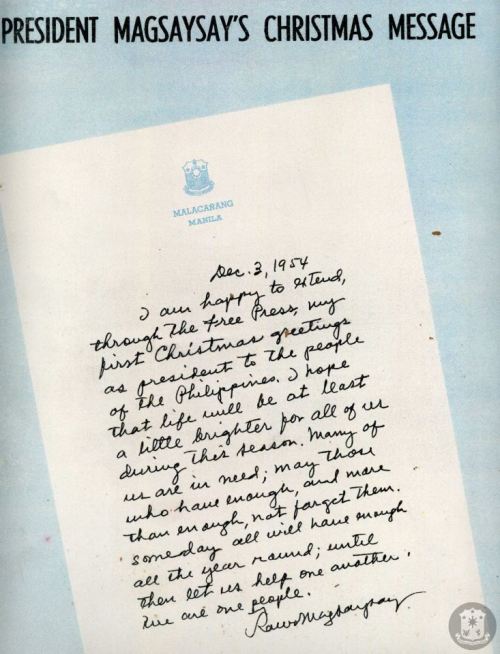
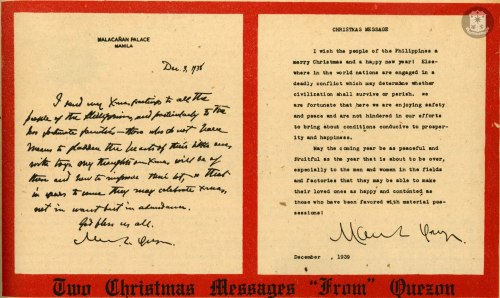
New additions, December 14-15, 2012
- Who owns this city? Editorial for October 3, 1908
- Marquardt Recounts Post-Landing Experiences, September 21, 1946 by Frederick Marquardt
- The Plight of the Displaced Population, February 22, 1947 by Federico Ayson
- They Saw Manoling for the Last Time, April 24, 1948 by Leon O. Ty
- In this corner: Lacson, May 11, 1957 by Quijano de Manila
- Strange Victory, November 23, 1957 (unsigned)
- The Phenomenon of Teilhard de Chardin, December 9, 1967 by Gregorio C. Brilliantes
- That was 1967, December 30, 1967 by Quijano de Manila
- Final round, November 1, 1969 by Napoleon G. Rama
- Remembering Teodoro M. Locsin, January 26,2002 by Manuel L. Quezon III
 The Philippines Free Press Online